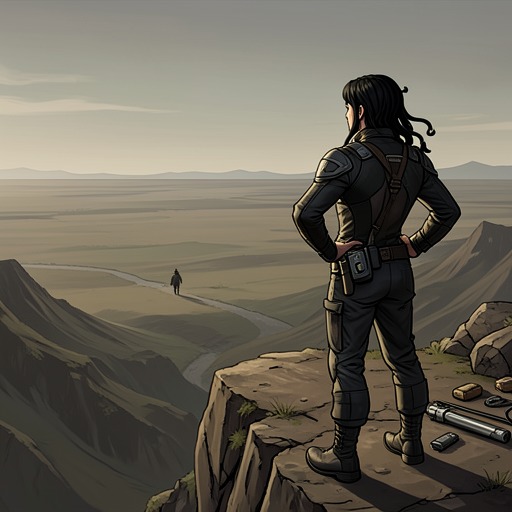
Joe Mulligan
The Stars Have EyesJoe Mulligan is introduced as the most unremarkable person in an extraordinary room: a young man stripped naked, chained to a stone altar, and selected as the human sacrifice in the Cult of the Gazing Star's attempt to summon Magh'rathlak the Observer. His plain body and apparently unimpressive mind make him seem expendable, yet his response to the ritual overturns that judgment. While the cult seeks to end the universe, Joe remains strangely free of fear, and that composure attracts the summoned entity's attention. The story's central relationship begins not with power or heroism, but with an ordinary man whose emotional steadiness proves more unusual than any supernatural spectacle around him.
Identity and Circumstances
Joe belongs to the post-scarcity society of Butterpond-4, where the vast mega-city Dave-156 contains roughly one-third of the planet's seventeen billion inhabitants. He is not a celebrated professional, soldier, genius, or political figure. After graduating with terrible scores across the aptitude tests, he receives an “Unemployable” designation and accepts that he is neither strong, fast, smart, nor destined for important work. His self-description is not presented as temporary embarrassment but as the settled condition of his life: he has little status, little ambition, and few reasons to expect that the wider world will notice him.
That marginality is intensified by the society around him. V-Life supplies food, drink, sleep, clothing, health care, hygiene, entertainment, and social contact through virtual reality, allowing Joe to spend nearly all his time immersed in artificial experience. Yet the platform cannot remove the crushing loneliness caused by the absence of physical human contact. Joe admits that without V-Life he might resort to bizarre rituals simply to make life feel less empty. His existence therefore occupies an ironic middle ground: material insecurity has largely disappeared, but purpose, recognition, and embodied connection remain scarce.
The Summoning and the Bond
The Cult of the Gazing Star sees Joe only as an anonymous offering. Its members are desperate, disturbed, manipulable, or dangerously foolish, and they believe that summoning a Class-3 cosmic entity will let them leave a mark by bringing the universe to an end. Joe is bound to the altar while the cult performs its preparations, but he does not display the panic expected of a victim. Magh'rathlak notices that his body is ordinary and his mental faculties seem unimpressive, yet Joe has endured the entire crisis without even a twitch of fear. The supposed sacrifice consequently becomes the most interesting specimen in the chamber.
When the entity addresses him by name, Joe does not answer with a grand revelation or a claim to hidden greatness. His later explanation of his calm is almost aggressively practical: the situation was his own fault, whatever happened next was outside his control, and stressing over it would accomplish nothing. This attitude becomes one of his defining strengths. Joe does not defeat cosmic terror; he refuses to grant it more emotional power than the circumstances warrant.
Magh'rathlak proposes a pact in which the Observer will bind itself to Joe, guard and nurture his fragile being, and use him as a guide and anchor while studying reality. The terms materialize on sinister parchment in shining red ink, turning their relationship into both a supernatural contract and a domestic arrangement. Joe becomes the anchor for a being capable of perceiving the universe, while Magh'rathlak becomes responsible for protecting the ordinary man who first caught its attention. The hierarchy is therefore unstable from the beginning: the cosmic entity possesses immeasurable power, but Joe supplies the human orientation that makes its contact with reality meaningful.
Maggie and Joe's Relationship
Maggie's human appearance is modeled almost exactly on the character Joe had been imagining. She is beautiful and physically convincing, but her disguise cannot fully conceal the entity beneath it. Her raven-black hair moves as though alive, her irises resemble swirling gateways into an unspeakable void, and her unusually pale skin feels subtly wrong to the touch. Joe nevertheless responds to Maggie as a person rather than reducing her to the horror beneath her appearance. Their relationship grows from curiosity into companionship, and then into love, even though its foundation remains a pact between a mortal anchor and a cosmic being learning how reality works.
Joe's attraction is complicated by uncertainty. He wants intimacy with Maggie but worries about how to raise the subject, whether she will agree, and whether an unsatisfactory first encounter will make her reject any future one. These concerns reveal an anxious, recognizably human vulnerability that contrasts with Maggie's cosmic scale. His feelings are not merely the response of a lonely man to an available companion; he becomes invested in whether Maggie chooses him, understands him, and remains emotionally present.
The relationship also exposes Joe's moral boundary. When he confronts the cruelty associated with Maggie's cosmic nature, he insists that the girl he loves would never force senseless suffering on another person. His defense is significant precisely because he knows Maggie is more than human. He does not claim that the danger is imaginary; he separates the person he loves from the destructive possibilities of the entity she embodies. When he fears that she may not trust him, the conflict is not about physical power but about whether their bond can survive the difference between Maggie's nature and Joe's understanding of her.
Physical contact becomes a recurring means of restoring Maggie's human manifestation. During one crisis, Joe holds her head and kisses her; he feels something pass from his throat into her, and after several breaths she returns to her familiar pale form, swirling eyes, and writhing hair. The kiss is consequently both romantic gesture and practical intervention. Joe's body serves as an anchor in the literal sense, while affection becomes a mechanism through which Maggie can remain recognizable as Maggie.
Separation and Joe's Reclamation of Agency
Maggie's departure is the decisive wound in Joe's trajectory. When she declares that she must leave him, Joe loses the person who transformed his isolated life into a meaningful relationship. His earlier passivity had been partly comfortable: V-Life filled his days, and Maggie made him feel that he was more than a faceless figure in the crowd. Without her, the same society appears as a box rather than a refuge. He had accepted his lack of distinction as a reasonable price for a life free of worry, but the relationship teaches him that comfort without genuine connection is not enough.
Joe's father provides a second pressure toward independence. After Joe visits him, the older man tells him to become his own man instead of allowing others to guide him. Joe later revisits that advice while trying to care for Maggie's vessel. He is still simple and limited, and his efforts are not immediately successful, but he begins to understand responsibility as something he must actively assume rather than something a stronger person can perform for him.
The change is visible in his decision to act after Maggie is gone. He tries twice and fails twice, then prepares for a third attempt with time, money, effort, and deliberate resolve. The cold cup of tea beside him marks the ordinary physical setting of an extraordinary undertaking: Joe is not suddenly transformed into a powerful hero, but he is no longer waiting for events to determine his life. His agency emerges through persistence, preparation, and the willingness to risk failure.
The Final Summoning and Narrative Role
Joe's desperate plan is to recreate the ritual that originally summoned Magh'rathlak, hoping to draw Maggie out if she cannot return on her own. He revives the Cult of the Gazing Star, studies the notes, recordings, and comments left behind by the entity, and persuades Maggie's vessel to transfer those materials into digital form. He learns the ceremony's exact requirements, including the once-a-year planetary alignment, the chants, the props, and the necessary devices. The act is dangerous and absurdly methodical at once: Joe answers cosmic loss with research, preparation, and ritual repetition.
At the ceremony he chants the required phrase repeatedly, turning private grief into an imitation of the original public summoning. The repetition links his attempt to the cult's earlier ritual while changing its purpose. The cult wanted the universe destroyed; Joe wants one person restored to him. The same ceremonial machinery therefore shifts from apocalyptic fanaticism to personal devotion, though the danger of confusing love with possession remains part of the scene's tension.
When a presence answers and Joe cautiously asks whether it is really Maggie, the question carries the full uncertainty of his arc. He has learned to act without certainty, but he cannot guarantee that the being drawn back will be the woman he loved rather than another manifestation of Magh'rathlak. Joe's significance lies in this unresolved threshold. He begins as an expendable sacrifice and an “Unemployable” resident of a lonely virtual society, becomes the anchor of a cosmic relationship, and ends by choosing action for himself. His apparent ordinariness is not erased; it is precisely what gives the story its human measure, allowing cosmic horror, romantic attachment, social alienation, and personal responsibility to be judged against one vulnerable person's stubborn capacity to care.